Contrarian Convictions: Enterprise Sales Beliefs by Dan Holly

CONTRARIAN CONVICTIONS

INTRO

"What important truth do very few people agree with you on?" This question from Peter Thiel's Zero to One reveals the sharpest ideas in technology.

I learned the most from leaders that shared ideas that made me uncomfortable the first time I heard them. If your sales tenets don't make a few people stir, you're likely just sharing platitudes.

The best Enterprise salespeople are filled with contrarian convictions. Here are a few of mine.

1

Your competition is likely not your competition

There may only be 1—or if you're really lucky 3—good reasons to buy your product. Unfortunately for sellers, there are many more reasons why not to buy.

The Jolt Effect research, based on analysis of 2.5 million sales conversations, found that 40–60% of qualified pipeline is lost to "no decision" — not to competitors. Once purchase intent is established, customers stop caring about succeeding. They start caring about not failing. This is the shift from FOMO (fear of missing out) to FOMU (fear of messing up).

Matt Dixon, co-author of The Jolt Effect, states it bluntly: "At the end of the day, a customer doesn't really care about a 10% discount window. What they really care about is losing their job." The research revealed a counterintuitive finding: dialing up FOMO backfires 87% of the time, actually increasing the odds of losing to no-decision.

The JOLT framework offers a systematic response. Judge the level of indecision (overwhelmed? still researching? risk-averse?). Offer a recommendation — stop asking what they want and tell them what they should do. Limit exploration — help them stop the endless research loop. Take risk off the table through implementation support, phased rollouts, and specialised contract terms. High performers wrap customers in what Dixon calls a "blanket of services" — essentially transferring perceived risk from the buyer to the seller.

Stop selling the upside. Start eliminating the downside. Your customer's decision paralysis will kill more deals than your competitor's product ever will.
2

You learn far more from success than failure

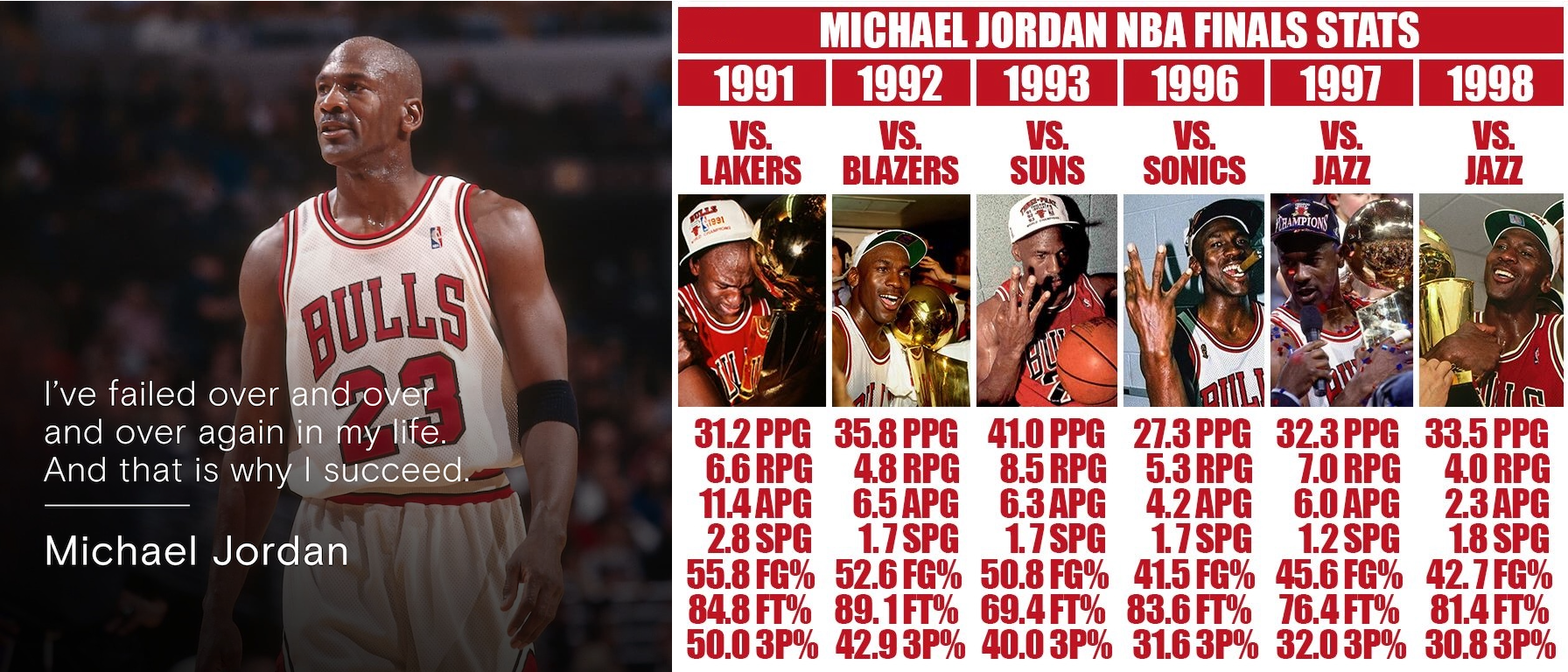
Michael Jordan NBA Finals Stats

Michael Jordan said, “I've failed over and over and over again in my life. And that is why I succeed,” but he also did a lot of winning when it counted. We romanticise failure because it makes for a better story, but the truth is that Jordan's greatness wasn't forged in missed shots — it was forged in championships, in the relentless repetition of what winning actually feels like. Failure teaches you what doesn't work. Success teaches you what does, and more importantly, it teaches you what it takes to stay there. The people who grow the fastest aren't the ones who fail the most — they're the ones who get close enough to excellence to study it, absorb it, and internalise its habits.

That's why who you surround yourself with matters more than almost any other career decision you make.

Interesting things happen when you are around the best. Your standards shift. What felt impressive last year starts to feel like the baseline. You stop celebrating effort and start expecting outcomes, not because you've become ruthless but because the people around you have quietly redefined what normal looks like. Netflix popularised the concept of talent density, building their entire culture around the idea that a smaller team of exceptional performers will always outpace a larger team of average ones. They talked about their team like an Olympic Team — not a family, not a community, but a squad where every single person earned their spot and could be replaced if someone better came along.

While the philosophy has its sharp edges, the underlying insight is hard to argue with — proximity to greatness is the fastest accelerator there is. You don't learn to operate at a higher level by reading about it. You learn it by being in the room where that level is the expectation, where success isn't a surprise but a standard, and where the people around you make you better simply by refusing to accept anything less.

3

Reverse demos are the maximum truth-seeking

A reverse demo is when you hand the controls back to the prospect and ask them to show you how they do things today. Instead of walking them through your platform, you ask them to walk you through their workflow, their current tool, or the process they're trying to fix.

The mechanic is simple. At some point during or after your demo, you say something like: "Can you show me how your team handles this today?" or "Walk me through what this looks like in your current setup." Then you stop talking and let them drive.

They work because they do three things at once. First, they surface real pain — not the pain the prospect told you about in discovery, but the pain you can actually see when they fumble through a six-click workaround they've normalised. Second, they shift the prospect from evaluator to participant. The moment someone is showing you their screen, the dynamic changes — they're invested, they're narrating their own problems out loud, and they're building their own case for change. Third, they give you ammunition you can't get any other way. You now have their language, their edge cases, and a firsthand view of the gaps your platform fills.

What the best enterprise sellers do during a reverse demo is mostly listen. They take notes on exact phrasing the prospect uses to describe their frustrations. They screenshot or record the workflows with permission. They ask "and then what happens?" repeatedly. And they resist the urge to jump in with a solution — because the longer the prospect sits in their own inefficiency, the more urgency they create for themselves.

4

Customer empathy and customer obsession over everything

Google Cloud CEO Thomas Kurian encourages his team by saying, "Customer empathy — you have to understand where they are, how you can help them. Every legacy system exists for a reason. Meet customers where they are and be deeply sympathetic."

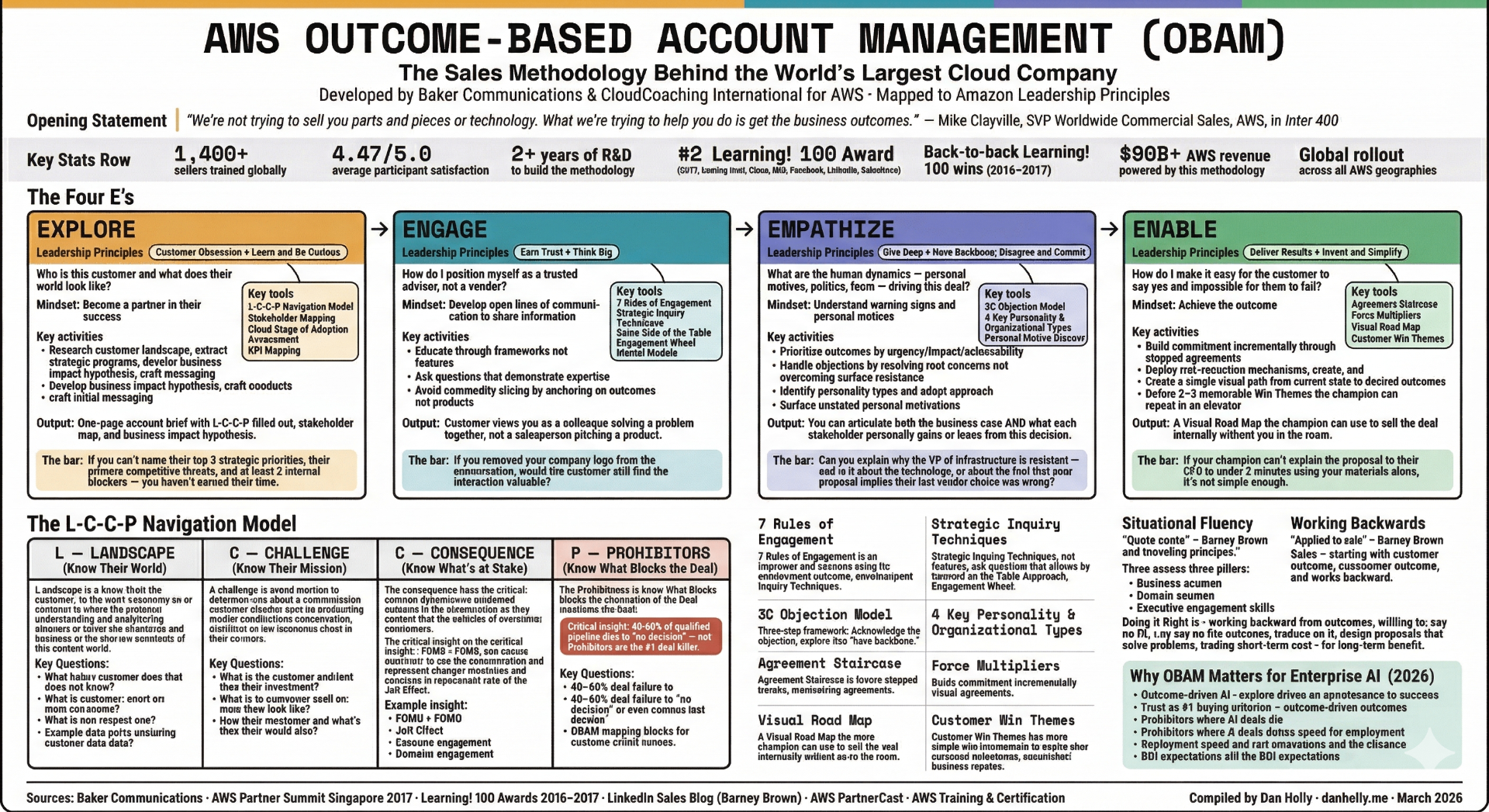
AWS codified their Customer Obsession Leadership Principle into their OBAM (Outcome-Based Account Management) sales methodology, built around four E's: Explore, Engage, Empathise, Enable.

AWS Outcome-Based Account Management (OBAM)

GKE and ECS differences aside, both Cloud providers have come to realise that a deep understanding of your customer is required in a complicated sales process with multiple stakeholders and teams coming together to make a decision. Sandler pain funnels work in SMB but will get tossed out of the room with seasoned executives. Enterprise customers must be heard, understood and guided empathically throughout a growth and digitalisation process.

5

Make a habit of “pattern interrupts”

We all lead busy lives. If an executive is not paying attention to you, it's likely not your fault.

Keep your structure familiar enough that people can follow but break the rhythm often enough that they can't tune out.

The moment your audience settles into a pattern — you change something. You're three minutes into a product walkthrough and you stop sharing your screen to ask a direct question. You skip past the slide everyone expects and say "I'm going to assume you've seen a dashboard before — let me show you the thing your current vendor can't do." You open a meeting with the one metric from their earnings call that no other seller in their pipeline bothered to read.

President Barack Obama famously peppered his speeches with umms and ahhs — not because he couldn't help it, but because flawless delivery sounds rehearsed and rehearsed sounds like you're being sold to. The pauses made him sound like he was thinking in real time, and that made people lean in rather than tune out. The same principle applies in a boardroom. The most polished presentations are often the least effective because polish signals predictability, and predictability is the fastest way to lose a room full of people who sit through five of these a week.

The best enterprise sellers I've watched don't just present well. They perform well. They read the room in real time, and when the energy dips, they have the instinct and the confidence to go off-script and pull people back in.

6

Selling across cultures: why your playbook is a cultural artifact

Winning in APAC is not one strategy — it's six or seven running in parallel. Japan and South Korea are mature, high-ACV markets that justify full local teams — local AEs, local SEs, local leadership. Australia is a different profile but the same rule: Aussies buy from Aussies. Singapore is your regional hub, but the rest of Southeast Asia gets sold through partners. GSIs like Accenture and Deloitte for enterprise credibility. Regional SIs like NTT Data and Tech Mahindra for implementation. Local firms like ADA and Transcosmos for in-market reach and language. The partner motion isn't a placeholder for a real GTM — it is the GTM until the economics say otherwise.

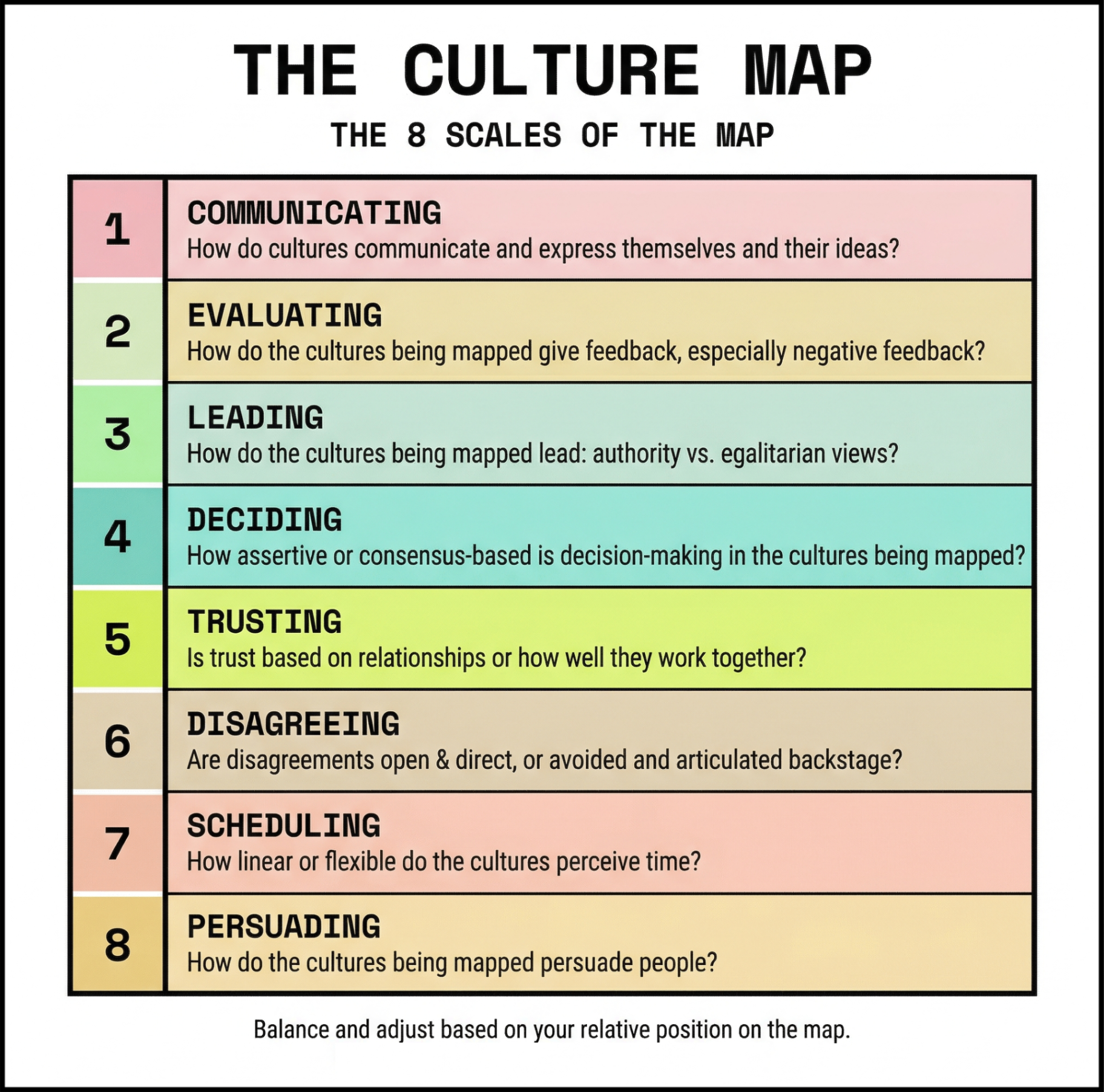
The reason this matters goes deeper than headcount planning. Erin Meyer's The Culture Map framework lays out eight dimensions where cultures diverge — communicating, trusting, deciding, disagreeing, persuading, leading, evaluating, and scheduling — and APAC is where those dimensions swing the widest within a single theatre. Japan is high-context, relationship-trust, consensus-driven. You cannot sell into a Japanese enterprise with a fast-talking AE running a challenger-style demo over Zoom. The real decision is being made in rooms you'll never be invited to, and a "yes" in a meeting often means "we've heard you" not "we're buying." South Korea moves similarly on trust and hierarchy but faster once internal alignment clicks. Australia sits on the opposite end of almost every scale — low-context, direct, egalitarian — which is exactly why a Singapore-based rep covering ANZ will always lose to a competitor with boots on the ground in Sydney.

Erin Meyer's Culture Map - The 8 Scales

Erin Meyer's The Culture Map framework identifies eight dimensions where cultures diverge — and enterprise sellers who ignore these dimensions lose deals they should win. The gap is starkest when you compare European and Asian selling environments. Most Western European markets (Germany, the Netherlands, Scandinavia) sit on the direct, task-based trust, low-context end of the scales. A German procurement team will tell you exactly where you stand, negotiate explicitly, and expect you to do the same. Swap that playbook into Southeast Asia and you'll misread every room you walk into. Across much of Asia, communication is high-context, trust is relationship-based, disagreement is indirect, and consensus often matters more than the opinion of any single decision-maker. A European seller who reads silence as agreement, politeness as alignment, or a nod as a commitment will build a pipeline full of deals that never close.

Meyer's critical insight for sellers: relative positioning matters more than absolute positioning. You don't need to know where Japan sits on an absolute scale — you need to know where Japan sits relative to your own culture. The American VP who believes people always say what they mean and mean what they say — and if they don't, they're lying — will build a forecast full of phantom deals across half of Asia.

Your sales playbook is a cultural artifact, not a universal truth. In Japan, silence is an answer. In Australia, directness is respect. In India, "yes" means "I hear you." Adapt or lose.

7

Territory discipline: customer-facing time and the 70/20/10 rule

Field reps spend only 35–39% of their available time in front of customers due to being bogged down working on the wrong things. Measure your customer-facing time. Optimised territory plans push this toward 60–70%. To increase your customer time, start by tiering accounts into A (20+ high-value touchpoints per quarter), B, and C (3 touchpoints per quarter), and review alignment quarterly.

Use a 70/20/10 framework for territory management that mirrors Google's innovation model just applied to sales time: 70% on existing accounts and high-probability deals (the revenue engine), 20% on developing accounts showing buying signals, and 10% on pure greenfield prospecting.

Time is the scarcest resource in enterprise sales. The 70/20/10 rule isn't about being rigid on your exact time allocation percentages — it's about the discipline to say no to the 50 accounts that feel urgent so you can say yes to the 5 that actually matter.

8

The Four L’s Build Operational Rigour

Loved

What worked? Which formats landed? Which motions built the foundation for success?

Loathed

What slows our deals? Where do we lose momentum? What internal friction is most painful?

Longed For

What would have made this easier? Better competitive enablement? Faster legal review?

Learned

What new objections surfaced? What commercial insights emerged?

Four L's retrospective was popularised through Atlassian's Team Playbook. Before taking on a new team or account, a sales leader can use the framework to add structure to their listening tour and ensure feedback is shared and understood across the team. The activity covers Loved: What worked? Which formats landed? Which motions built the foundation for success? Loathed: What slows our deals? Where do we lose momentum? What internal friction is most painful? Longed For: What would have made this easier? Better competitive enablement? Faster legal review? Learned: What new objections surfaced? What commercial insights emerged? You'll use Figjam or Miro to ensure everyone gets to share their opinion and all feedback is documented. The team will go L by L starting a 3-5 minute timer to write, followed by a short discussion on what everyone wrote.

The "Longed For" column can be consolidated, prioritised, and requested for investment from leadership. The "Learned" becomes a best practice list. And the sales leader gets to work to ensure the "Loved" and "Loathed" categories are fully understood and followed up on across the team.

Now, before suggesting new operating motions for a team that may have been working together for months or years, you've done a proper listening and understood more through the 4L's. When you instill new processes and drive operational rigour, you'll be doing so with credibility, candour and empathy.

9

Qualification never stops

MEDDPICC has become the dominant qualification framework at elite tech companies because it instills a stronger rigour and discipline within a senior sales force. MEDDPICC leaves stylistic choices aside and cuts to the core of any deal. Because there's not much more sobering than sitting on a sales forecast and getting your deal disqualified because you aren't up to speed on how and why your customer is buying from you. This winning methodology has the simplest insight: "If you cannot name your Economic Buyer, confirm your champion has real influence, or tell your manager what the paper process looks like, you do not have a qualified deal. You have a relationship."

AI SDRs can gather BANT, and tools like Gong can auto-score calls against MEDDPICC criteria, extract qualification signals, and push data to CRM without rep input. But human judgment — knowing when a "champion" is really a coach, how to ensure alignment with an EB — is what makes a great enterprise seller.

The best enterprise deals I've closed all had the same inflection point: the moment the buyer stopped evaluating us and started selling internally on our behalf. Our job as sellers in early stages is to pressure-test whether that moment is even possible. If it isn't, we've got to walk.

10

The “Unteachables” still hold the keys to success

Stay hungry, be a team player, and be dedicated to developing mastery in your craft. This alone will make almost anyone successful.

You can teach product knowledge. You can teach a sales methodology. You cannot teach hunger, empathy, or the ability to thrive in chaos. Hire for the unteachable.

11

The psychology of elite sellers: confident detachment and the abundance mindset

Positive mindset - Ironman athlete

Desperation is the most expensive emotion in enterprise sales. The deals you need least are the deals you close most. Confident detachment isn't indifference — it's the freedom to do what's right for the customer without the weight of your quota distorting your judgment.

Gong.io found that sales reps who speak with conviction achieve 36% higher win rates. Harvard Business Review reported that 40–60% of deals stall because buyers lack confidence in their own decision-making. Confident salespeople help eliminate that doubt. The mechanism is neurological: mirror neurons cause buyers to subconsciously mirror the seller's emotional state. Your calmness becomes their calmness.

The distinction between abundance and scarcity mindset is operationally significant. Scarcity mindset ("I need this deal") creates neediness that prospects sense instantly, leading to over-discounting and desperation. Abundance mindset ("I don't need any one sale") creates the psychological safety for tough questions and honest conversations. Jeb Blount, author of Sales EQ, crystallised the operational difference: average performers obsess over outcomes ("I need to close this deal"), while elite performers focus on process ("I'm going to run my process perfectly").

Martin Seligman's landmark study at MetLife Insurance found that reps scoring well on optimism sold 57% more than pessimistic counterparts in their first two years. The practical framework: before every call, visualise a successful outcome but detach from needing it. The reframe for rejection: "That person wasn't ready, or we weren't a good fit."

CONCLUSION: BELIEFS WORTH FIGHTING FOR

FINAL

The AI era hasn't made enterprise sales easier — it has made the gap between the best and the rest wider. If you've struggled to find your footing in the profession before this point and have still not found your stride, it may be time to find a new career path.

Andreessen Horowitz's research on AI sales (November 2025) identified the most important shifts: 70% of buyers report speed of deployment as a top factor when engaging AI vendors. 57% of buyers expect positive ROI within three months. Buyers, on average, are more than half the way through the buying process before ever approaching a seller and 89% of buyers report they themselves identified a business problem and initiated their purchase journey independently, without the help of a seller. Speed is a prerequisite.

Demos are replacing POCs and the product is an AI company's #1 salesperson. This is especially true when selling to more technical buyers like engineers and developers. In response, GTM teams are becoming fundamentally more technical. Enterprise Sales reps must know their way around the product and have a strong grasp of AI terminology and concepts. Technical expertise is expected.

The companies reshaping the enterprise technology landscape trade on trust. Anthropic believes trust matters more than growth. OpenAI believes quotas are counterproductive. AWS believes selling is truth-seeking, not persuasion. Google Cloud believes in customer empathy. Trust is non-negotiable.

Finally, the contrarian convictions above can be synthesised down to a simple concept: the best enterprise sellers don't sell at all. They diagnose. They teach. They reduce risk. They build conviction in their buyers by being more honest, more prepared, and more genuinely invested in the customer's outcome than anyone else in the room. That's not a sales technique. That's a set of beliefs worth fighting for.

Built in Singapore 🇸🇬. © 2026 Dan Holly