Strategic Account Planning · A Manifesto · October 2026
Enterpriseaccountplanningisnotaslidedeck.It'stheoperatingsystemofenterpriserevenue.
01.1 · The asymmetry
In every enterprise territory, the math is brutal.
A handful of accounts produce most of the revenue. Not 8020. Closer to 9010. A single Tier-1 strategic account often outweighs the bottom thirty combined.
This isn’t a phase you grow out of. It’s the structure of enterprise. Time spent on a Tier-4 account at the expense of a Tier-1 isn’t neutral — it compounds into a loss that shows up two renewal cycles later.
The whole purpose of an account plan is to make that asymmetry deliberate instead of accidental.
01.2 · The cycle length
Enterprise deals don’t close in quarters. They close in years.
The bank you’re working today was being sold to by your competitors before you joined your company. The CFO who agrees to the POC may not be the CFO who signs the contract. The champion who pushed for the pilot may have moved by the time you renew.
Without a plan that survives the people who wrote it, you’re not running a territory — you’re running a relay where the baton keeps getting dropped.
01.3 · What planning actually is
Account planning is not paperwork. It’s the discipline of compounding context.
The output is a referenceable customer, a renewal that closes itself, and an expansion thesis already underway. The absence of it is a graveyard of accounts where you’ve burned trust and forgotten what you learned six months ago.
- 01Knowing the org chart better than the person who hired you.
- 02Documenting power so the team can act in your absence.
- 03Naming the trigger that makes now the right time to buy.
- 04Multi-threading deeply enough that one resignation can't kill the deal.
- 05Adding to your understanding every quarter, so the next conversation starts where the last one left off.
01.4 · The bar has moved
AI didn’t make enterprise selling easier. It raised the floor.
The research that used to take a week now takes a morning. Your buyer assumes you’ve done it. Showing up to an executive meeting without having read the last earnings transcript, mapped the org, and pressure-tested your hypothesis against the company’s public strategy isn’t conservative — it’s negligent.
The seller who treats account planning as a chore is competing against sellers who treat it as their edge. Those are not the same race.
A contrarian conviction that shapes how I plan enterprise accounts. It is not consensus. It is the price of admission to the discipline.
Your competition is not
your competitor.
Decision paralysis kills more deals than rivals do.
There may only be 1 — or if you're lucky, 3 — good reasons to buy your product.
There are many more reasons not to.
sales conversations analyzed by the Jolt Effect research team
Where qualified pipeline goes
Once purchase intent is established, customers stop caring about succeeding. They start caring about not failing.
FOMO — Fear of missing out. Top of funnel.
FOMU — Fear of messing up. Decision moment.
The shift from FOMO to FOMU is where most enterprise deals die.
At the end of the day, a customer doesn't really care about a 10% discount window. What they really care about is losing their job.
Matt Dixon — co-author, The Jolt Effect
of the time, dialing up FOMO backfires
Increasing urgency on a paralyzed buyer doesn't unstick them. It confirms their fear that the decision is too risky.
THE FRAMEWORK · J O L T
Judge
The level of indecision. Are they overwhelmed, still researching, or risk-averse? Diagnose before you prescribe.
Offer
A recommendation. Stop asking what they want. Tell them what they should do based on what you’ve seen work.
Limit
Exploration. Help them stop the endless research loop. More options doesn’t mean better decisions.
Take
Risk off the table. Implementation support, phased rollouts, specialized contract terms — transfer the risk to you.
High performers wrap their customers in what Dixon calls a "blanket of services" — transferring perceived risk from the buyer to the seller.
Stop selling the upside.
Start eliminating the downside.
Your customer's decision paralysis will kill more deals than your competitor's product ever will.
Now: how to stay current on the accounts that matter.
02 · Industry Intelligence
How to stay up to date on key accounts.
- 01Google News Alerts
- 02LinkedIn (.csv account upload, set personas)
- 03Coffee with other Enterprise Sellers
- 04Earnings calls & transcripts
- 05Annual reports & 10-Ks
- 06Company press releases
- 07Social media activity
- 08Perigon (AI news aggregator)
03 · Account Tier Prioritization
Not all accounts deserve the same investment. Prioritize ruthlessly.
Highest ARR potential. Full account plan. Executive sponsor assigned. Quarterly EBRs.
04 · Territory · Operating System
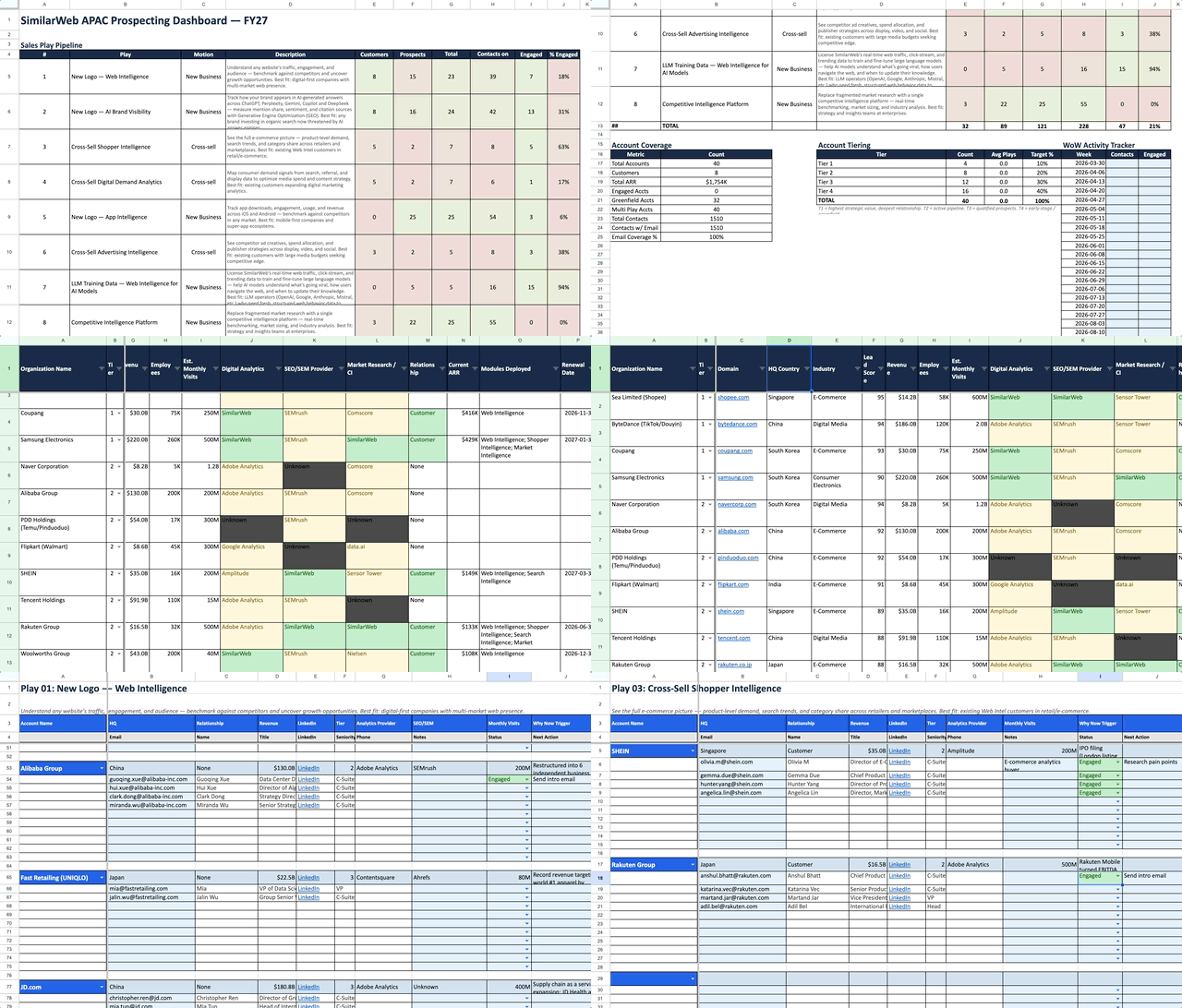
40 accounts. 1,510 contacts. One operating system.
Built as the working artifact behind an enterprise account-planning masterclass for ~9 AEs across Singapore, Tokyo, and Sydney.
01 · Reframe · Operating System
Most reps spend Monday morning building plans. This sheet means they don't have to.
A working artifact, not a planning deck. Forty APAC accounts, 1,510 enriched contacts, eight sales plays — all wired into one hub-and-spoke workbook the team executes against, not from.
02 · The Artifact · In Motion
Type the account. The plan fills itself in.
A master Accounts sheet drives eight play-specific worksheets through cross-sheet XLOOKUPs. Type a name and HQ, revenue, monthly visits, the "Why Now" trigger, and the current vendor stack auto-populate. Type a contact email and title, LinkedIn and seniority resolve from a Raw Contacts repo of 1,510 records. AEs aren’t building plans on Monday — they’re executing against one.
03 · Displacement · Why Now + Vendor Stack
Every row is a displacement plan, not a prospect list.
Two columns do most of the work. Why Now captures the specific event creating urgency — a search-share collapse, an IPO roadshow, an acquisition. Vendor stack names who’s currently winning the budget you want — Adobe, SEMrush, Comscore, Sensor Tower. Together they answer the two questions that matter on a first call: why this account right now, and what am I displacing.
04 · Override · Human In The Loop
The data flags the plays. The rep picks the fights.
The All Accounts tab auto-detects which plays each account qualifies for. The Prioritizer sheet is where the algorithm gets overruled — manual rankings and final ✅/❌ checks where the rep validates what’s actually go versus no-go. The workbook never pretends the data is the strategy. It makes the strategy editable on top of the data.
05 · One Source · Shared View
The forecast. The prep. The QBR. Same page.
A weekly activity tracker, dashboard rollup, and per-play engagement rates mean the rep stops recapping the territory in every 1:1. Manager forecasts off it. SE preps off it. CSM inherits it. Exec sponsor reads it before the flyover. The rep stops being the bottleneck for everyone else’s job.
05 · Working relationship
Customer Success and Sales, together.
For AEs
Go high and wide. Multi-thread into new teams, use cases and C-suite. Explore DaaS. Drive the expansion motion.
For CSMs
Own value realisation and account health. Be the voice of the customer in the renewal cycle. Flag expansion signals to the AE.
Together
Shared account plans. Joint EBRs. CSM presents value delivered, AE presents the account vision. Divide and conquer — owe each other a summary after every meeting.
AE is CEO. CSM is COO.
06 · Getting to power
Always know the names of their executives — and their bosses.
"Who do you report to?"
Generic. Lazy. Tells the prospect you didn't do your homework.
"I noticed you recently hired Cathy Wood as your new CMO. Your boss — Nick Lee — does he report directly to Cathy, or is there a layer in between?"
Shows preparation. Earns trust. Maps the org.
Go prepared. Research the org chart before the call. Use LinkedIn, earnings calls, press releases. Dive into previously signed agreements in Salesforce — know the signatories.
07 · Three Levels of the Org Chart
Which part of the organization is most important to know?
Worked example: Grab Holdings — illustrative only. The point is the levels, not the names.
C-Suite & Executive Heads
- Koh Boon Hwee — Independent Chairman
- Anthony Tan — CEO & Co-Founder
- Group Executive Committee — COO, CFO, CTO, CPO, CCO, General Counsel
- Regional MDs — Indonesia, Malaysia, Philippines, Vietnam, Thailand
- Business Line Heads — GrabFood, Financial Services, GrabAds, GrabMart
Marketing & Growth Leadership
- Rachel Tan — VP Marketing & Growth
- Performance Marketing
- Growth
- Brand Marketing
- Marketing Intelligence
Data, Analytics & Strategy
- Dr. Wee Kim Seng — Chief Data Officer
- Vivian Loh — VP Data Products
- Martin Loh — VP Strategy & Insights
- Business Intelligence · Data Science · Competitive Intelligence · Market Research
08 · Consultant Mindset
You get delegated to the part of the organization you sound the most like.
The 30 minutes between your executive and theirs is the highest-leverage moment in your deal cycle.
09 · Account Planning
What good looks like.
One page anyone on the team can read in 2 minutes and understand the account.
Document MEDDPICC. Share your understanding to organize the team behind your account vision.
Stakeholder map rating each contact on Health and Importance, with a buying role.
Create a growth plan for every Tier-1 account. Break it down into small actions.
Updated quarterly and revisited. Not filed away in a forgotten slide deck.
10 · 18-Month Account Roadmap
Pick your most important account. Map the next 12–18 months.
Audit & Foundation
- ▸Stakeholder mapping
- ▸MEDDPICC baseline
- ▸Competitive landscape
- ▸Identify multi-threading gaps
- ▸Set DaaS hypothesis
- ▸Align with CSM
First Expansion Motion
- ▸Identify lead expansion play
- ▸Build executive access
- ▸Pilot DaaS hypothesis
- ▸First QBR with growth vision
- ▸Deepen 2nd function
Strategic Scaling
- ▸Multi-thread across functions
- ▸QBR cadence locked
- ▸Grow consumption metrics
- ▸Executive-to-executive rhythm
- ▸2nd expansion play live
Full Account Ownership
- ▸Embedded as strategic partner
- ▸Renewal confidence ≥ 90%
- ▸Next deal cycle planned
- ▸Referenceable customer
- ▸DaaS pipeline live
Cross-functional swimlane
| Workstream | Apr–May 2026 | Jun–Jul | Aug–Sep | Oct–Nov | Dec–Jan 2027 | Feb–Mar (Renewal) |
|---|---|---|---|---|---|---|
| Commercial | Renewal risk assessment | Start commercial talks | Add-on product discussion | Negotiate terms | Quote-to-cash | Contract renewed |
| Exec Meetings | QBR with VP Digital | — | EBR with C-suite | — | Exec-to-exec call | Renewal SteerCo |
| Product | New module demo | Pilot / POC | — | Integration build | — | Production rollout |
| Services & Support | Health check | Config optimization | Onsite Training Day | — | Adoption sprint | — |
| Value & Outcomes | Baseline KPIs | Customer outcome plan | ROI report | ROI story w/ champion | Case study dev | Value summary |
End of brief
Thank you.
Dan Holly · in/danholly3 · v1.0